
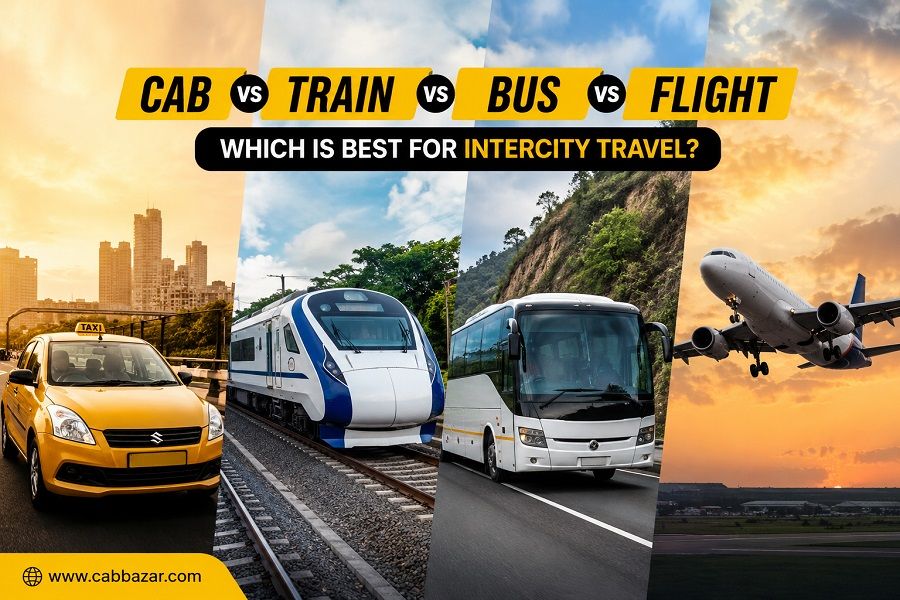
Every trip between cities is not the same thing as you need to find the perfect option form Cab, train, bus, or plane? The prices change and the schedules never match. They all claim to be the fastest, cheapest, and best mode of travel. It's very confusing and wastes money as well in many cases.
People pay too much for a flight they didn't really need. Others are stuck on a slow bus when a train would've been quicker. This is supposed to clear that up. Planning an intercity trip? Book a cab for a private, door-to-door journey with flexible stops
Book an Outstation CabTable of Contents
- Why Do People Get Confused Choosing Between Them?
- What Exactly Are We Comparing Here?
- What Is an Outstation Cab and Who Should Use It?
- What Is Train Travel and Who Should Use It?
- What Is Bus Travel and Who Should Use It?
- What Is Flight Travel and Who Should Use It?
- Quick Comparison Table: Cab vs Train vs Bus vs Flight
- Real-Life Examples: What Different Travellers Actually Choose
- What Factors Should Actually Decide Your Choice?
- Pros and Cons of Each Travel Mode
- When Should You Choose Each Option?
- How Can You Save Money on Intercity Travel?
- What Mistakes Do People Commonly Make While Choosing?
- Conclusion
- FAQs
Why Do People Get Confused Choosing Between Them?
There's no one-size that fits-all answer.
A student alone versus a family of five totally changes what works. Someone on a tight deadline needs something else than a group just out for the weekend. People get confused comparing just price and forgetting about time, comfort, and just general ease.
Like, Rohan flew from Pune to Mumbai because it seemed fast. By the time he got to the airport, did the whole check-in thing and then took a cab from the Mumbai airport to his office, he realizes a direct cab from his house would have actually taken less time.
Common reasons people get confused:
- They compare only the ticket price, not the total cost
- They forget door-to-door time, not just travel time
- They ignore luggage, group size, and comfort needs
- They choose out of habit, not based on the actual trip
What Exactly Are We Comparing Here?
This thing is about trips between two different cities which is generally confused with getting around town.
We're talking about going out of town with a cab, train, bus, or plane. We factor in all the things like cost, time, comfort, convenience, safety and how flexible it is.
So, Jaipur to Delhi, about 280 km, that's intercity. Just getting around Jaipur to catch a flight? That's local, not part of this.
What Is an Outstation Cab and Who Should Use It?
An outstation cab picks you right from your door at pickup time and takes you wherever you're going (destination you have entered).
No changes, no stopping somewhere else. You book it, and they pick you up at home or your hotel and drop you exactly where you wanted to be. You have complete control on the stops, how fast you go and the route of you wanted to take.
Families going from Chandigarh to Manali, for instance, often go with a cab. They can pack their stuff, pull over for pictures, and get right to their hotel
An outstation cab works well when:
- You are travelling with family or in a small group
- You have heavy or awkward luggage
- You want to stop along the way
- Your destination is not well connected by train or flight
What Is Train Travel and Who Should Use It?
Trains move a lot of people over long distances, on a set schedule, and for a set price.
You get on the train at one station and get off the train at your station. Trains move on dedicated tracks, so they don't really get stuck in traffic and the prices are also the same every day.
Example: A college student going from Kanpur to Delhi might book a train because it's cheap, predictable and they can sleep through the night instead of paying for a hotel and save money. But if the luggage is a lot then a Private Vehicle is an equally good option.
Train travel works well when:
- You are travelling alone or in a large group
- You want a fixed, predictable price
- You are comfortable with a station, not a door-to-door pickup
- The distance is medium to long, and time is not extremely tight
What Is Bus Travel and Who Should Use It?
Buses are the mostly available on all routes and are usually the cheapest way to travel between cities.
Buses take roads so they reach small towns that trains and flights do not go to. Tickets are easier to book comparatively; you can book even a few hours before departure without any surge fees.
Example: A group of friends travelling from Chennai to Pondicherry takes overnight bus. The trains do not run directly and a buses are way cheaper than booking a cab for the same route.
Bus travel works well when:
- Your destination is a small town or city
- Budget is the biggest priority
- You are booking on short notice
- The distance is short to medium (under 500 km)
What Is Flight Travel and Who Should Use It?
Flights are the fastest way to cover long distances over 700 km.
You travel by air, which is why flights save the most time on long routes above 10-12 hours. But you need to spend extra time on airport check-in and security and the ticket prices are also on higher side.
Example: A business person flying from Mumbai to Bangalore for a same-day meeting takes a flight, because train or cab would take most of the day just to travel and is a lot tiring as well.
Flight travel works well when:
- The distance is long, usually over 700 km
- Time matters more than cost
- You are travelling for work, on a tight schedule
- Both cities have well-connected airports
Quick Comparison Table: Cab vs Train vs Bus vs Flight
Here is a simple side-by-side look at how each option usually performs. Actual numbers vary by route and season.
| Factor | Cab | Train | Bus | Flight |
|---|---|---|---|---|
| Best for distance | Under 400 km | 300–1,200 km | Under 500 km | Over 700 km |
| Cost (per person) | High for solo, low for groups | Low to medium | Lowest | High |
| Door-to-door? | Yes | No (station to station) | No (stand to stand) | No (airport to airport) |
| Comfort | High, private | Medium to high | Basic to medium | High, but short duration |
| Flexibility | Highest, you set stops | Fixed schedule | Fixed schedule | Fixed schedule |
| Booking notice needed | Same day is fine | Book early for good seats | Same day is usually fine | Book early for best price |
| Weather impact | Moderate | Low | Moderate | High |
Real-Life Examples: What Different Travellers Actually Choose
The right choice depends on who is travelling, not just where. Here are five common situations.
Example 1: Family Trip From Delhi to Agra (230 km)
A family of four heading from Delhi to Agra, about 230 km. They've got two young kids and a ton of luggage. They absolutely need easy stops and a comfy ride. A cab is pretty much the best bet. No dealing with station madness, plus they can just grab food when they want on the highway.
Example 2: Solo Traveller From Bangalore to Goa (560 km)
For a solo traveler going from Bangalore to Goa, a distance of 560 km. They're on a budget and don't have a hard schedule. An overnight train or a sleeper bus makes the most sense. It's cheaper than flying, and you save a hotel room cost.
Example 3: Business Trip From Mumbai to Delhi (1,150 km)
A business trip from Mumbai to Delhi, a long haul at 1,150 km. They have a meeting and need to get back the same day. A plane is the only realistic choice. The train or driving would just eat up way too much of the day.
Example 4: Group of Friends From Chennai to Pondicherry (170 km)
Four friends driving from Chennai to Pondicherry, which is only 170 km. They can totally split expenses and want to stop and see things along the way. Either a hired cab or driving themselves works. Splitting a cab often ends up being less than four bus tickets, and you get way more freedom.
Example 5: Senior Citizens From Lucknow to Varanasi (320 km)
Some senior citizens traveling from Lucknow to Varanasi, a 320 km trip. Comfort and feeling safe is the main thing, not necessarily getting there super fast. A train with a lower berth or a private cab would be good. Long bus rides can really wear out older folks on this route.
What Factors Should Actually Decide Your Choice?

Eight factors matter more than habit or assumption.
- Distance: Short trips favour cab or bus, long trips favour flight
- Budget: Bus is usually cheapest, flight is usually costliest
- Group size: Cabs get cheaper per person as the group grows
- Time sensitivity: Flights save time on long routes only
- Luggage: Cabs handle heavy or bulky luggage best
- Comfort needs: Matters more for elderly or unwell travellers
- Route connectivity: Small towns often lack train or flight access
- Weather and season: Flights are affected the most by weather delays
Pros and Cons of Each Travel Mode
| Mode | Pros | Cons |
|---|---|---|
| Cab | Door-to-door, flexible stops, private, good for groups | Costly for solo travel, affected by road traffic |
| Train | Affordable, punctual on tracks, comfortable for long rides | Fixed schedule, station transfers needed, tickets sell out early |
| Bus | Cheapest option, reaches small towns, easy last-minute booking | Less comfortable, longer travel time, road traffic delays |
| Flight | Fastest for long distance, reliable schedules on clear days | Most expensive, airport time adds up, weather delays |
When Should You Choose Each Option?
When Should You Choose a Cab?
Choose a cab when you're in a group, got lots of stuff, or just want to stop when you feel like it. Good for distances under about 300 km.
When Should You Choose a Train?
Trains are good for a set price, if you don't mind getting to the station. Works for medium to longer trips, especially if they're overnight.
When Should You Choose a Bus?
Choose buses for when money is tight, or you're going somewhere small with no train or airport. Also good if you book last minute.
When Should You Choose a Flight?
Choose flights for when the trip is long, over 700 km, and you need to save time more than money. Best bet for tight, same-day plans.
How Can You Save Money on Intercity Travel?
- Book train and flight tickets at least 2–3 weeks in advance
- Split cab fare with co-travellers going the same route
- Compare the total cost, including food and any local transfer, not just the ticket
- Travel on weekdays instead of weekends, where prices are usually lower
- Use overnight trains or buses to save on a night's hotel stay
- Check if a nearby smaller airport or station offers a cheaper fare
What Mistakes Do People Commonly Make While Choosing?
- Booking a flight without adding airport travel time to the total
- Choosing a bus for a very long distance and losing a full day
- Booking a solo cab for a long route, which often costs more than a train
- Ignoring luggage size before choosing a train or flight
- Not checking weather before flying on a monsoon or foggy route
- Assuming the cheapest ticket is always the cheapest trip overall
Conclusion
Taxi, train, bus, flight: all great options, they are good at different things. When traveling you must choose based on distance, cost, size of group and available time. Before going off on your next trip ask three simple questions. How far do i need to travel? how many people will be traveling with me? And finally, what is my time worth? The answer to these three questions, will correctly identify the correct transport for your needs every single time. Ready to travel? Enter your route, compare your cab options, and book your intercity ride.
Install App & Book your CabFAQs
Which travel option is best for a family trip between cities?
When you’re travelling with a family, a cab often makes the most sense. You can all ride together, select where and when you’ll be picked up and dropped off, bring your luggage with ease, and make stops along the way for any pit stops you or your kids may require.
How much does an intercity cab usually cost compared with a train or bus?
If you're traveling solo, it can be more expensive to book a cab than a train or bus for intercity travel. If you have 3 to 4 people to share with it makes more sense. Cabs also offer you to be picked up and dropped off from one location to another.
Is booking a cab in advance better than booking a train or bus ticket?
Booking your seats for trains and buses before travel is recommended, especially when you are traveling around the time of a festival, holiday, or holiday. A pre-booked car will guarantee you vehicle and pick up time.
Which is better for a short-distance journey: cab or train?
If you are traveling on a short-distance journey between two cities, it would probably be best to utilize a cab, as this will offer you to pick up and drop off between two doors.
When is flying not worth the extra cost for an intercity trip?
A flight does not necessarily make sense if the trip is not of sufficient length. The travel time to the airport, through security, waiting at the gate, picking up baggage and transferring could easily eat up hours.
Can I stop anywhere during an intercity cab journey?
You can generally request stops along the way in an intercity cab trip. Plan ahead if you require stops for lunch, restroom breaks, sightseeing or work so that additional waiting and charges are not incurred.
Are cabs better for destinations with limited public transport?
Yes, a cab is a very practical mode of transport for destinations that are not serviced by regular bus or train services. Cabs are a door-to-door transport. It’s especially very helpful for people visiting small towns, secluded spots, sightseeing places, villages, and the destinations that lie too far from the railway stations or bus stands.
Which travel option is best for remote destinations without railway stations?
The cabs can be a very good travel choice when going to remote destinations away from railway stations. They usually take you straight to your destination through a door-to-door cab service and can reach where buses can’t.
Which mode of transport provides the most privacy?
A private cab will generally be the most private way to travel since you are the only ones travelling in it (apart from the cab driver you chose). You have personal space, privacy for conversations, you control stops and the routes. Trains and buses include communal seats while flights has less personal space and specific travel rules.
Are flights affected more by weather than cabs and trains?
Flights can be significantly influenced by a number of types of weather including, low visibility, thunderstorm storms and heavy rains, and high wind levels. Tacks and cabs can also be influenced by weather due to high tides and stormy weather, but depends on the terrain as well as weather-specific limitations.
Which travel option is least affected by cancellations?
There are none, train and bus services can be canceled as result of operations; however, flights can be affected by weather or air-carriers reasons. Cabs have more independent travel for you but can be impacted by storms, floods, closure of roads and vehicle break downs.
Train vs cab: Which is better when travelling with luggage?
Cabs can be more suitable for transporting many bags because you can load them straight from their point of origin rather than through stations and terminals. Trains are more optimal for very extensive routes or limited budget travel.
How does travel time really compare between cab, train, bus, and flight?
Usually flights take the least time in the air – but one also needs to factor in the time taken for airport transfers (to and from), security check, board and collect your luggage. While train and bus tickets may take more time but requires minimum procedures.
Which mode of transport gives the best value for money?
The best value depends on your distance, group size, luggage, and priorities. Flights are economical on long distance, though. A cab can become value for money for families and groups as the overall cost can be distributed but you travel with ease of door-to-door travel and private commute.
Which is the best option for a last-minute intercity trip?
If you are planning an inter-city trip last minute, you can opt for a cab if there are no seats available on trains and buses. Cab allows you to get picked up from where you are, and you can skip waiting at stations. Flights might have fewer seats available at last moment and the fares would be sky high.
Which travel option gives the most flexibility?
A cab often provides with maximum flexibility. You can select your starting and ending point of the trip, your desired departure time and sometimes even requests small deviations or stops along the way. Trains, buses, and flights run as per their scheduled time and terminals, which can be less adaptable to sudden changes.